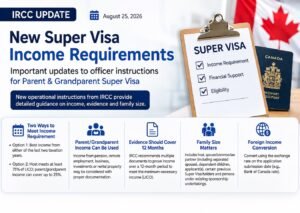
Immigration, Refugees and Citizenship Canada (IRCC) has updated its operational instructions for the Parent and Grandparent Super Visa, providing important guidance on how officers assess the new Super Visa income requirements introduced in 2026.
The operational instructions were modified on August 25, 2026 and explain how hosts can establish the Minimum Necessary Income (MNI), when a visiting parent or grandparent’s income can be considered, what evidence may be accepted, how foreign income should be converted into Canadian dollars, and who must be included when calculating family size.
The underlying Ministerial Instructions took effect on March 31, 2026. The August operational update is particularly important because it provides more detailed guidance on how these requirements are applied when a Super Visa application is assessed.
What Changed With the Super Visa Income Requirements in 2026?
The Super Visa allows eligible parents and grandparents of Canadian citizens, permanent residents and persons registered as Indians under the Indian Act to visit Canada for extended periods.
One of the central eligibility requirements is demonstrating that the Canadian host has sufficient income to financially support the applicant during their authorized stays in Canada.
Under the current rules, there are now two different ways of satisfying the Super Visa income requirement.
The first allows the host to rely on their best income from the previous two taxation years.
The second creates an alternative where the host meets at least 75% of the required income and the visiting parent or grandparent’s qualifying income is used to supplement the remaining amount.
This second option represents a significant change for families whose Canadian income falls slightly below the applicable threshold.
Option 1: Host’s Best Income From the Previous Two Taxation Years
Under Option 1, the host and an eligible co-signer, if applicable, must demonstrate that their combined income meets or exceeds the applicable Low Income Cut-Off (LICO).
IRCC can consider either of the two taxation years immediately preceding the submission of the Super Visa application.
This means a host is not necessarily restricted to their income from only the most recent taxation year.
For example, if the host’s income declined during the most recent taxation year but exceeded the applicable LICO in the preceding taxation year, that earlier year may potentially be used to establish the financial requirement.
What documents can establish income under Option 1?
IRCC identifies the Canada Revenue Agency Notice of Assessment (NOA), or an equivalent document issued by the Minister of National Revenue, as acceptable evidence.
The updated operational instructions also provide an important clarification.
Where an NOA is unavailable or does not capture all of the host’s income for that taxation year, an officer may also consider the host’s:
-
- T4; or
-
- T1.
The income must still meet or exceed the most recent LICO applicable to the family’s size.
Option 2: Host Meets 75% of LICO and Parent or Grandparent Supplements the Income
The second option substantially changes how some families may establish financial eligibility for a Super Visa.
Under Option 2, the host and eligible co-signer, if applicable, should demonstrate income equal to at least 75% of the applicable LICO.
The Super Visa applicant’s qualifying income may then be used to supplement the Canadian host’s income.
However, the applicant’s contribution is limited to a maximum of 25% of the applicable LICO.
In other words, the new rule does not allow the visiting parent’s income to replace the host’s financial requirement entirely. The host and co-signer must first satisfy the minimum 75% threshold.
Example
Assume the applicable LICO for a particular family size is $80,000.
The host would need to establish at least:
75% × $80,000 = $60,000
If the host has qualifying income of $64,000, the parent or grandparent could potentially provide qualifying income to cover the remaining $16,000.
However, if the host earned only $55,000, the parent’s income could not simply be added to reach $80,000 because the host has not independently reached the required 75% threshold.
The actual assessment will depend on the applicable LICO, family size, relevant income period and evidence submitted with the application.
Can a Parent’s Income Now Be Used for a Super Visa?
Yes, in qualifying cases.
One of the most significant aspects of the 2026 changes is that a visiting parent or grandparent’s own income may now be considered when the host is proceeding under Option 2.
The applicant’s income is supplementary. It can generally account for no more than 25% of the applicable LICO after the host and co-signer establish the required minimum portion.
This may be particularly relevant where a parent or grandparent continues to receive reliable income from sources such as a pension, remote employment, a business, investments or rental properties.
Can Both Parents’ Income Be Used?
Potentially, yes.
Where a host invites both parents or both grandparents, IRCC’s operational instructions provide that the income of both visiting parents or both visiting grandparents may be considered to supplement the host’s income for the applicable family size.
The instructions concerning the invitation letter similarly state that where both parents, both grandparents, or a parent and their spouse or common-law partner apply for Super Visas at the same time, their incomes may be combined to meet the remaining portion of LICO.
This does not remove the requirement for the Canadian host and co-signer, where applicable, to satisfy the host portion of the income requirement.
What Income Period Does IRCC Consider Under the 75% Option?
The August 25 operational instructions provide an important clarification concerning the relevant income period.
Under Option 2, the host and co-signer may provide evidence concerning their total income during the most recent 12-month period or taxation year preceding the date the application is submitted to IRCC.
IRCC specifically indicates that a host may choose Option 2 where they want to demonstrate the income requirement using their income from the most recent 12 months preceding the application.
This can be important for someone whose present financial circumstances are stronger than the income shown on their previous tax return.
For example, a host may have:
-
- recently received a substantial salary increase;
-
- moved from part-time to full-time employment;
-
- started a higher-paying position;
-
- returned to employment after a period away from work; or
-
- otherwise experienced an increase in income that is not fully reflected in the latest NOA.
The supporting evidence must nevertheless be sufficient to establish the qualifying income.
Documents for the Host’s Most Recent 12-Month Income
For Option 2, the NOA or equivalent CRA document for the most recent taxation year remains important evidence.
Where an NOA is unavailable, IRCC’s operational instructions indicate that officers may also consider evidence of the host’s Canadian income for the most recent 12-month period, including:
-
- T4 or T1 for the last taxation year;
-
- pay stubs;
-
- evidence of other income, such as pension statements;
-
- an original employer letter stating the person’s job title, job description and salary; and
-
- bank statements.
The evidence should establish the income actually being relied upon rather than simply demonstrating that the host is currently employed.
What Documents Can Parents Use to Prove Their Income?
The August 25 instructions provide detailed guidance regarding evidence that may be submitted to establish a Super Visa applicant’s income.
The appropriate documents depend on the source of that income.
Pension income
A parent or grandparent relying on pension income may provide evidence such as:
-
- pension statements covering the previous year;
-
- an official letter confirming the annual pension income; and
-
- bank statements from the previous calendar year showing regular pension deposits.
Remote employment income
Where the applicant continues working remotely, IRCC identifies evidence including:
-
- an official employment letter explaining the dates and remote conditions of employment and the applicant’s income; and
-
- bank statements showing at least 12 months of regular employment-income deposits.
The reference to the remote conditions of employment is particularly important. An employment letter showing only a job title and salary may not fully address the type of evidence contemplated by the operational instructions.
Investment or business income
An applicant relying on investment or business income may submit:
-
- bank statements;
-
- investment statements; and/or
-
- business statements demonstrating the level of investment or business income during the previous year.
Rental or leasing income
For rental or leasing income, the evidence may include:
-
- proof that the applicant owns the property;
-
- the rental or leasing agreement showing the amount of rent; and
-
- bank statements for the previous year demonstrating regular rental or lease deposits.
IRCC Recommends Evidence Covering 12 Months
A particularly important part of the updated instructions concerns the quality and duration of income evidence.
IRCC states that income evidence should cover a 12-month period to establish the ability of the host, co-signer and/or applicant to satisfy the Minimum Necessary Income requirement.
The operational instructions also indicate that applicants should generally consider providing multiple documents to establish their income.
The reason is evidentiary: corroborating documentation can increase the officer’s confidence in the claimed income and assist in establishing that the applicable LICO has been met on a balance of probabilities.
For example, where a parent relies on rental income, submitting only a property ownership document may establish ownership but does not necessarily establish the amount and regularity of rental income. A lease agreement together with bank statements showing corresponding deposits can provide a more complete evidentiary record.
How Does IRCC Convert a Parent’s Foreign Income Into Canadian Dollars?
Because many Super Visa applicants earn their income outside Canada, the updated operational instructions address foreign-currency conversion.
IRCC states that foreign income can be converted into Canadian dollars according to the conversion rate in effect on the date the Super Visa application was submitted.
A financial institution’s currency converter may be used, and IRCC specifically gives the Bank of Canada as an example.
This means applicants relying on foreign income should carefully document both the original income amount and its Canadian-dollar equivalent.
Who Counts Toward Family Size for a Super Visa?
Determining family size is critical because the applicable income threshold increases as family size increases.
IRCC’s operational instructions identify several categories of people who must be included.
The calculation includes:
-
- the host;
-
- the host’s spouse or common-law partner;
-
- dependent children of the host and the host’s spouse or common-law partner, including dependent children of dependent children;
-
- the Super Visa applicant;
-
- another Super Visa applicant applying at the same time, such as the applicant’s spouse or common-law partner;
-
- certain previously approved Super Visa applicants; and
-
- certain individuals subject to an existing sponsorship undertaking.
Incorrectly calculating family size can result in the wrong LICO being used and may therefore affect whether the financial requirement is met.
A Separated Spouse May Still Count
The updated operational guidance specifically notes that the host’s spouse included in family size might include a separated spouse.
This is an important distinction.
Applicants should not automatically assume that a spouse can be excluded merely because the spouses are currently separated. The particular circumstances and the applicable legal relationship should be reviewed when determining family size.
Dependent Children Count Regardless of Custody Arrangements
IRCC also expressly states that children who meet the definition of a dependent child must be included regardless of custody and child-support arrangements.
Therefore, a host should not exclude an otherwise qualifying dependent child from the calculation simply because the child:
-
- lives primarily with another parent;
-
- is subject to a shared-custody arrangement; or
-
- is covered by a particular child-support arrangement.
The applicable definition of dependent child remains important.
Previously Approved Super Visa Applicants Can Affect Family Size
Another potentially overlooked category is a previously approved Super Visa applicant.
IRCC’s instructions state that previously approved Super Visa applicants include Super Visa holders for whom the host or the host’s spouse or common-law partner signed or co-signed a letter of invitation, provided that the Super Visa remains valid.
This can have a significant impact where a family previously invited one parent or grandparent and later wishes to submit another Super Visa application.
The previous applicant may still need to be included when determining the applicable family size and LICO.
Previous Sponsorship Undertakings May Also Count
Family size may also include people previously sponsored by the host or co-signer where the applicable sponsorship undertaking remains in effect.
IRCC’s instructions indicate that this can include family members of the sponsored person, whether or not those family members were included in the undertaking.
Officers can review the Global Case Management System (GCMS) to determine whether the host or co-signer has previously sponsored individuals.
This makes it important to review previous sponsorship history before calculating the income requirement for a new Super Visa application.
Invitation Letter Requirements Under the New Rules
The host’s invitation letter has an important role in the financial assessment.
According to IRCC’s operational instructions, the letter and accompanying documentation must include, among other information:
-
- a promise to financially support the applicant for the duration of the authorized stays;
-
- the name and relationship of the host’s spouse or common-law partner where that person is acting as a co-signer;
-
- a list of everyone included in the family-size calculation, with their full names and dates of birth;
-
- a list of everyone whose income is being relied upon, including their full names and dates of birth; and
-
- a list of the documents submitted as evidence of income for each person.
Where applicant income is being used under Option 2, the invitation letter and supporting financial evidence should therefore be prepared consistently.
Other Super Visa Requirements Continue to Apply
Meeting the income requirement does not by itself establish eligibility for a Super Visa.
The applicant must also satisfy the other applicable requirements.
Among other things, an applicant must apply from outside Canada, meet the requirements applicable to temporary residents seeking entry as visitors and provide the additional documentation required under the Super Visa Ministerial Instructions.
Medical examination
The applicant must provide evidence of undergoing the required immigration medical examination so that admissibility under section 38 of the Immigration and Refugee Protection Act can be assessed.
Health insurance
The applicant must also have qualifying health insurance.
The policy must generally:
-
- be valid for at least one year from the date of entry;
-
- be paid in full or through permitted instalments with a deposit;
-
- provide coverage for health care, hospitalization and repatriation;
-
- provide at least $100,000 in emergency coverage per applicant;
-
- remain valid for each entry to Canada; and
-
- be available for inspection by a border services officer when requested.
An insurance quote by itself is not sufficient.
Qualifying coverage may be issued by a Canadian insurance company or, subject to the applicable requirements, certain foreign insurance companies authorized by the Office of the Superintendent of Financial Institutions (OSFI).
Why the August 25, 2026 IRCC Update Matters
The March 31, 2026 changes expanded the ways in which families may satisfy the Super Visa financial requirement.
The August 25, 2026 operational instructions are important because they provide detailed guidance on how IRCC officers assess those rules in practice.
For families preparing an application, some of the most significant points are:
-
- A host may qualify based on their income in either of the previous two taxation years under Option 1.
-
- Alternatively, a host meeting at least 75% of LICO may be able to supplement that income with qualifying income from the visiting parent or grandparent.
-
- Applicant income can generally account for a maximum of 25% of LICO.
-
- Where both parents or grandparents apply together, qualifying income from both applicants may potentially be considered.
-
- The host may rely on the most recent 12-month income period under Option 2.
-
- IRCC has provided specific examples of acceptable evidence for pension, remote employment, business, investment and rental income.
-
- Income evidence should generally cover 12 months, and multiple corroborating documents may strengthen the evidence.
-
- Foreign income may be converted using the exchange rate applicable on the application submission date.
-
- Family-size calculations require careful attention to dependent children, separated spouses, previous Super Visa holders and existing sponsorship undertakings.
Preparing a Super Visa Application Under the New Income Rules
The new rules provide additional flexibility, but they also make the financial assessment more detailed.
Before filing a Super Visa application, the host should determine:
-
- the correct family size;
-
- the applicable LICO;
-
- whether Option 1 or Option 2 is more appropriate;
-
- the correct income period;
-
- whether a co-signer’s income is required;
-
- whether the applicant’s income needs to be relied upon;
-
- whether that income falls within a category supported by appropriate documentation; and
-
- whether the financial records consistently establish the claimed income over the required period.
Where applicant income is being relied upon, particular attention should be given to the source, regularity and documentary evidence of that income.
The fact that income exists does not necessarily mean that it will automatically be accepted. The evidence must be sufficient for the assessing officer to be satisfied that the applicable financial requirement has been established.
This article provides general information and is not legal advice. Immigration requirements and program instructions may change. Individual circumstances should be assessed before an application is submitted.
Need Assistance With a Super Visa Application?
The 2026 Super Visa changes may provide additional options for families who previously could not meet the income requirement based solely on the Canadian host’s income.
However, determining family size, selecting the appropriate income option and documenting foreign income can require careful review.
Blue Iris Immigration assists clients with Super Visa applications, including eligibility assessment, financial-document review, family-size calculations and preparation of supporting documentation.
Applicants and hosts should assess their individual circumstances under the requirements in effect at the time their application is submitted.